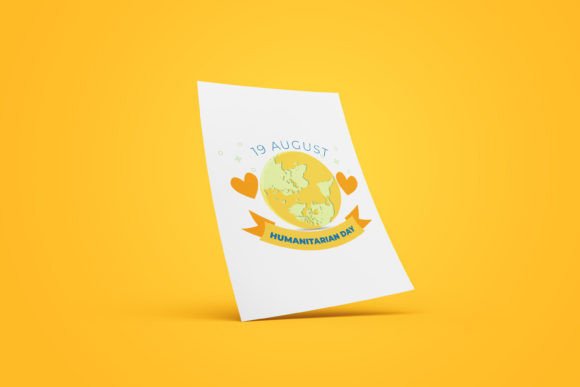
World Humanitarian Day Design SVG: Graphics for Purpose-Driven Web Elements
As a brand designer who’s helped over 200 local businesses—from neighborhood bakeries to handmade soap studios—build cohesive, shelf-ready identities, I opened the World Humanitarian Day Design SVG expecting symbolism, not spectacle. What I found was a quietly powerful graphic design asset: clean linework, balanced negative space, and subtle humanitarian motifs (doves, hands, olive branches) rendered in scalable vector form. It doesn’t shout—it invites. That makes it ideal for small business branding where authenticity and warmth matter more than flash.
This design leans into thoughtful elegance: neither overly ornate nor starkly minimal. It reads as organic yet intentional—perfect for a skincare brand launching a “Give Back” limited edition serum, a coffee shop supporting local aid initiatives, or a children’s product line donating proceeds to humanitarian causes. It feels handmade but professional, compassionate but confident. Not festive, not corporate, not rustic—but grounded, human, and quietly dignified.
Where This Graphic Design Asset Earns Its Place in Real Local Business Projects
I recently used the World Humanitarian Day Design SVG for a seasonal candle brand’s “Light for Relief” collection—hand-poured soy candles with packaging that needed to communicate care without cliché. Here’s how it performed across real-world touchpoints:
- Product labels: The SVG scaled flawlessly onto 2" x 3" kraft paper labels—no pixelation, no color bleed. Paired with a warm serif font, it created instant visual hierarchy and emotional resonance.
- Packaging accents: As a foil-stamped motif on matte black boxes, it added tactile sophistication without overwhelming the minimalist structure.
- Social media graphics: The transparent PNG layered cleanly over lifestyle photos—used across Instagram carousels, Facebook event banners, and Pinterest pins promoting the campaign.
- Thank-you cards & hang tags: Printed on recycled cotton stock, the design softened the transactional feel of a purchase and reinforced brand values at the moment of unboxing.
- Website hero banner: Embedded as an SVG in the site header, it loaded instantly and remained razor-sharp on mobile—critical for local SEO-driven traffic.
Why It Strengthens Small Business Branding—Beyond Aesthetics
For local business owners juggling production, sales, and storytelling, this isn’t just clipart—it’s strategic visual infrastructure. When applied intentionally, the World Humanitarian Day Design SVG delivers measurable business value:
- Stronger first impression: On crowded shelves or scroll-heavy feeds, its calm clarity cuts through noise.
- Better product recognition: Consistent use across labels, stickers, and digital ads builds associative memory—customers begin linking the motif with your mission.
- Clearer visual hierarchy: Its balanced weight anchors layouts without competing with essential text like flavor names, ingredients, or call-to-actions.
- More consistent brand identity: Whether printed on a compostable bag or animated in a Reel, the vector integrity ensures fidelity across mediums.
- Improved customer trust: Thoughtful humanitarian alignment—visually expressed—not only differentiates but deepens emotional connection with values-aligned buyers.
Best Uses: Where the Design Shines Most
The World Humanitarian Day Design SVG excels where intention meets execution:
- Product mockups for Etsy or Shopify listings—especially for handmade business owners needing polished, cause-connected visuals.
- Seasonal packaging updates (e.g., holiday gift sets with charitable partnerships).
- Boutique visuals: window decals, tote bags, or receipt tape for stores emphasizing community impact.
- Promotional banners for local events, farmers’ markets, or pop-ups aligned with humanitarian themes.
- Printable inserts for subscription boxes—pairing the design with short impact stories builds narrative cohesion.
Use With Care: Practical Boundaries for Professional Branding
Even strong design assets have limits. I advise caution when:
- Applying it to very small labels (<24pt height)—fine details may blur in print or lose legibility on curved surfaces.
- Placing it near dense ingredient lists or legal disclaimers—its symbolic nature shouldn’t distract from compliance-critical text.
- Using it in luxury minimalist brands where even subtle ornamentation contradicts core aesthetic discipline.
- Layering it over low-contrast backgrounds (e.g., light gray on off-white)—always test the transparent PNG against your actual packaging substrate.
- Integrating it into formal corporate branding—this is purpose-driven, not boardroom-ready.
Brand Designer Notes You Can’t Skip
Before finalizing any project using the World Humanitarian Day Design SVG, run these checks:
- Test it on a real packaging mockup—not just screen previews—especially for foil stamping or embossing.
- Check grayscale and black-and-white usage—some humanitarian motifs rely on subtle gradients that disappear in monotone.
- Preview it on small labels at actual print size—zoom out to simulate shelf viewing distance.
- Test it with your full brand palette—not just primary colors, but secondary and accent tones.
- Compare it side-by-side with top three competitor packaging designs—does it hold its own visually and tonally?
- Review print quality on your chosen stock—test the JPEG and PNG outputs separately; sometimes one renders cleaner than the other.
- Inspect SVG editability in Illustrator—can you isolate and recolor individual elements? (This matters for customizing across product variants.)
- Test typography pairings: Does it harmonize with your serif, sans serif, script, or display fonts—or does it visually compete?
- Confirm commercial licensing covers physical product sales, digital marketing, and client work—never assume.
When sourced ethically and applied intentionally, the World Humanitarian Day Design SVG becomes more than a decorative element—it’s a quiet amplifier of purpose. For local business owners building brands rooted in real community impact, it’s not just graphics or web elements. It’s visual integrity, made accessible.